Custom Software vs. Off-the-Shelf Software: Which Is Right for Your Company?
Choosing between custom software and an off-the-shelf system can have a significant impact on a company’s costs, productivity, integrations, and ability to scale.
On one side, off-the-shelf platforms can be deployed quickly and are designed to handle common business processes. On the other, custom software can be built around the specific workflows, rules, and integration requirements of an operation.
Neither option is automatically better.
The right choice depends on the problem you need to solve.
What is off-the-shelf software?
Off-the-shelf software is designed to address needs shared by many companies.
ERP systems, CRMs, financial management platforms, and other business applications are common examples.
Typically, a company purchases a subscription or license, configures the platform, and starts using it.
Some of its main advantages include:
- faster implementation;
- lower initial investment;
- features that have already been developed and tested;
- updates managed by the software provider;
- established support and documentation.
For standardized processes, an off-the-shelf solution can be an excellent choice.
Challenges arise when the operation has specific requirements the software cannot accommodate.
What is custom software?
Custom software is designed and developed to address the specific requirements of a company.
Instead of adapting business processes to an existing tool, the project starts by understanding how the operation works and which problems need to be solved.
Based on those requirements, companies can develop applications, portals, dashboards, integrations, automations, and other digital solutions.
The result is technology designed around the actual workflow of the business.
When is off-the-shelf software enough?
Not every business process requires custom development.
An off-the-shelf system may be the better choice when:
- the process is relatively standardized;
- mature solutions already exist in the market;
- little customization is required;
- implementation speed is important;
- the initial budget is limited;
- there are no highly specific integration requirements.
If an existing platform solves the problem effectively, building another solution from scratch may be an unnecessary investment.
When should you consider custom software?
Several signs may indicate that custom development is worth evaluating.
1. Your company has to adapt its processes to the software
When efficient business procedures must be changed simply because the software cannot support them, there may be a mismatch between the technology and the operation.
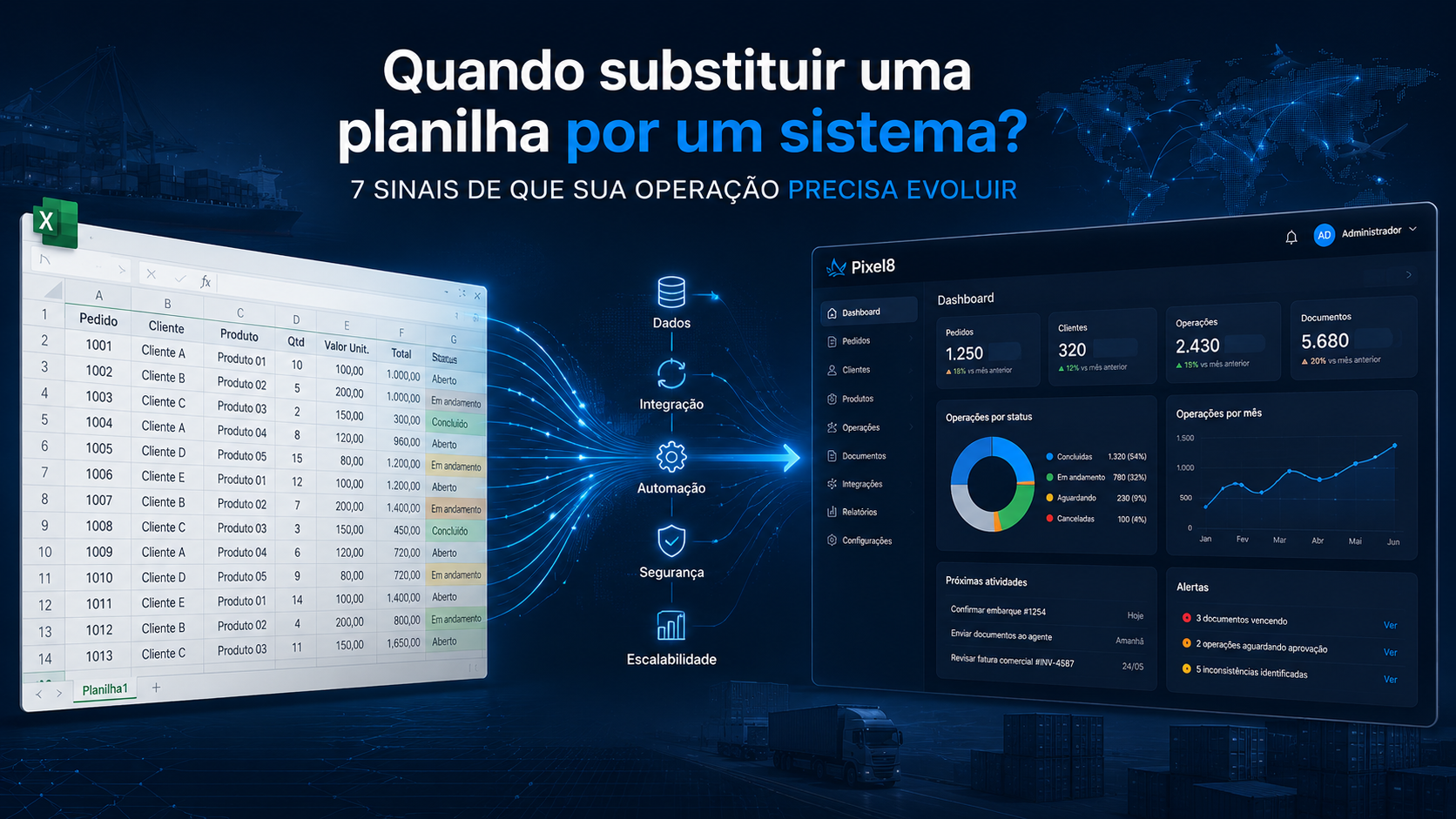
2. Spreadsheets are multiplying around the system
The company has software, but employees still maintain several spreadsheets to manage everything the platform cannot handle.
In practice, spreadsheets become an improvised extension of the system.
3. The same information is entered multiple times
Data is entered into the ERP, copied to a spreadsheet, sent by email, and later entered into another platform.
Besides consuming time, this workflow increases the risk of inconsistencies and human error.
4. Your systems do not communicate
A company may already use good applications, but they operate independently.
In this situation, replacing them may not be necessary.
An integration could solve the problem.
5. The process is strategically important
The more specific and strategically important a process is to the company’s competitive advantage, the more valuable a solution built specifically around it may become.
Is custom software always more expensive?
The initial investment is usually higher than subscribing to an existing SaaS platform.
However, comparing only subscription fees or upfront development costs can be misleading.
The current cost of the process should also be considered.
How many hours are spent on manual tasks?
How many employees are involved?
What is the cost of an error?
How much rework occurs?
How much time is spent consolidating information?
Are opportunities being lost because the process cannot scale?
In some scenarios, automating repetitive work can generate enough savings to justify the investment.
The analysis should therefore consider total cost, productivity, and return on investment, rather than software price alone.
Integration may be better than replacing your existing software
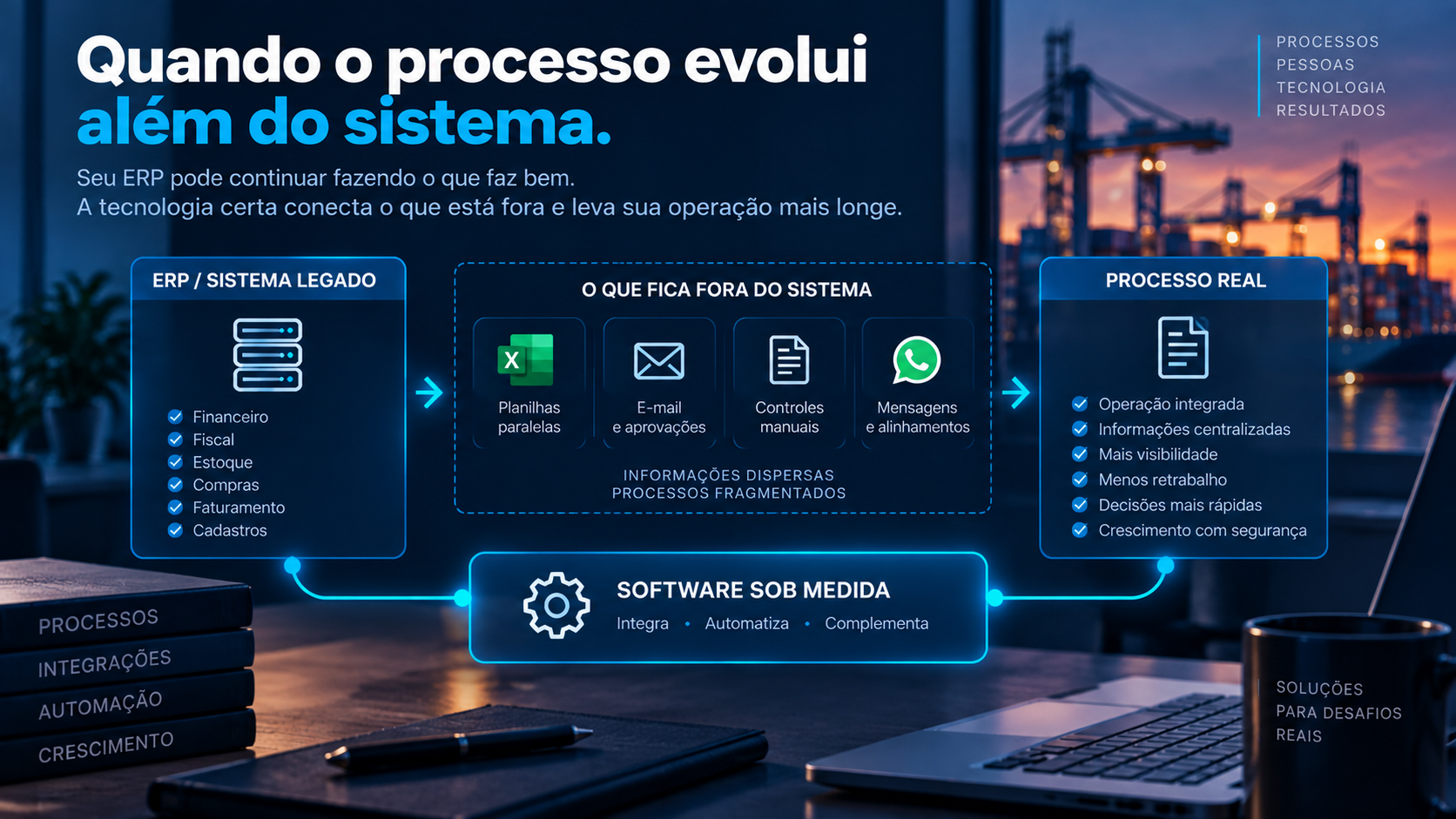
There is also a third option between keeping everything as it is and building an entirely new system: integrating the tools you already have.
A company may have an ERP that works very well for financial and accounting processes but does not adequately support a specific operational workflow.
Instead of replacing the ERP, a complementary application can be developed and connected through APIs.
The same approach can be used with CRMs, logistics platforms, internal applications, portals, and other systems.
The objective is to preserve what already works and develop only the missing technology layer.
What about automation?
Not every problem requires a complete new application.
Sometimes the bottleneck is a sequence of manual tasks.
Copying data.
Checking documents.
Updating systems.
Generating reports.
Sending notifications.
Retrieving information from other platforms.
These activities may be good candidates for automation.
Before starting a development project, it is therefore important to determine whether the problem requires new software, an integration, or simply an automation.
Custom software for international trade operations
International trade is a good example of an environment where multiple technologies need to coexist.
A single operation may involve ERP software, spreadsheets, documents, freight forwarders, customs brokers, carriers, internal applications, and government platforms.
When these sources are disconnected, specialized professionals may spend part of their time manually moving information between tools.
Custom development, APIs, and automation can help connect these different stages of the operation.
The goal is not simply to add more technology.
It is to reduce manual work, improve information flows, and provide better visibility across processes.
How should you choose?
Before deciding between off-the-shelf and custom software, consider these questions:
- Is there an existing solution that adequately supports the process?
- How much would your operation need to change to use it?
- How many parallel controls would remain?
- Are there repetitive tasks that could be automated?
- Can your current systems be integrated?
- Is this process strategically important to the business?
- What is the current cost of inefficiency?
- Will the solution need to scale with your operation?
The answers will help determine the most appropriate path.
The best software is the one that solves the problem
Off-the-shelf and custom software are not competitors.
They are different approaches for different needs.
In many cases, adopting an existing platform will be the most efficient decision. In others, system integration may be enough. And there are situations where unique operational requirements justify developing a custom solution.
The decision should begin with the process, not the technology.
Understand the problem first. Then choose the technology.
Software development for international trade
Pixel8 develops custom software, integrations, automations, and AI-powered solutions for international trade operations.
We start by understanding the process and identifying where technology can reduce manual work, connect information, and address requirements that existing systems cannot adequately support.
Is there a process in your company that existing software does not handle well? Talk to Pixel8 and find out how we can help.